When Light Moves in Your Hands — The Story of a New Kind of Light Toy, SHAKE SYNC
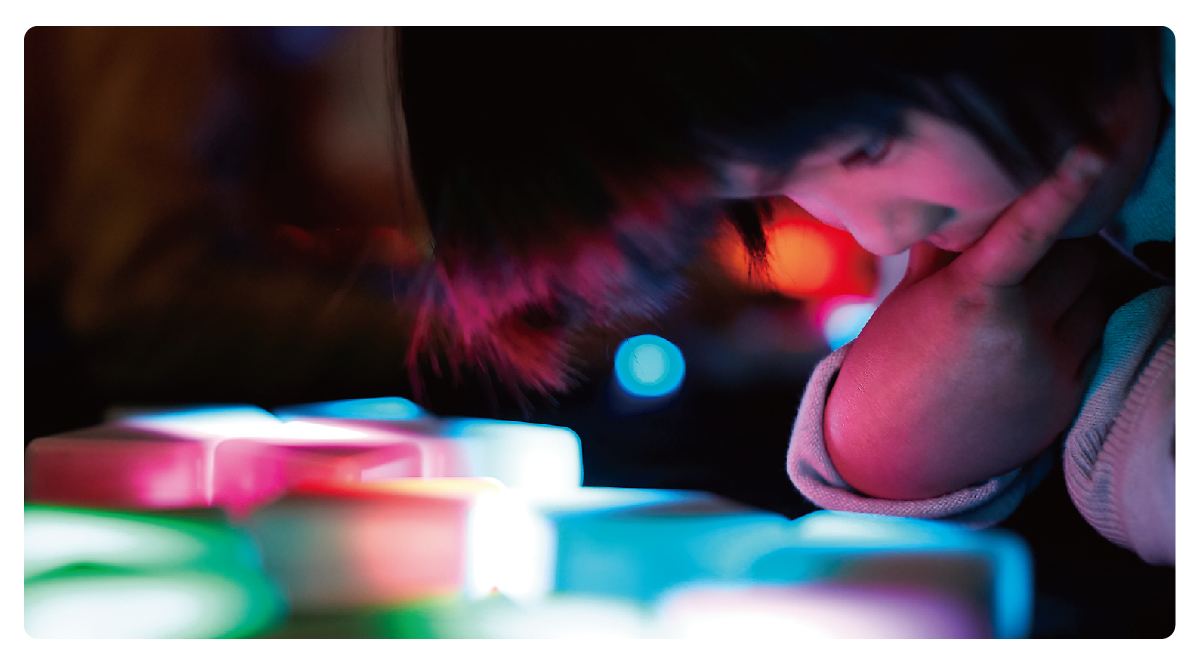
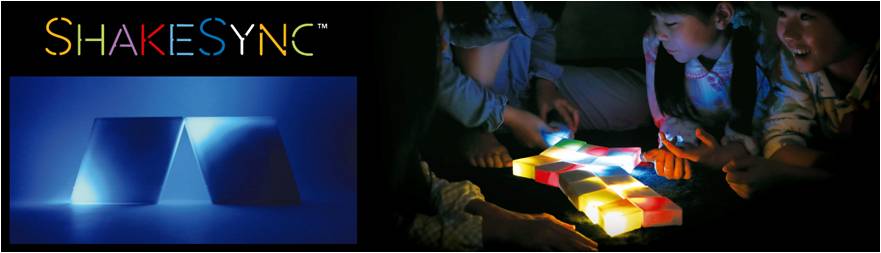
Shake it, and the light changes color. Bring it close to another block, and the color quietly moves across to its neighbor. That's all it does. And yet — children and adults alike lose track of time, transfixed by this small event in the palm of their hand.
SHAKE SYNC is a block-shaped product made for exactly that: playing with light. Here is a slightly longer telling of how it came to be, and why it's so much fun.
It Began as a Fish
The real starting point wasn't SHAKE SYNC at all — it was a laboratory at Osaka University.
Teruo Kamiyoshi, a researcher at Osaka University's Institute of Scientific and Industrial Research (SANKEN), had been developing a technology that made LEDs flicker like candlelight. It generated the gentle rhythm people find soothing — the so-called "1/f fluctuation" — through electronics: not a uniform blink, but a living, wavering glow. The technology was sound, but it was still searching for a purpose.
oxoxo (zero by zero) was the first to fall for that light. Working with Kamiyoshi, we built the very first prototype using it: "Fish." A fish-shaped object that glowed as if slowly breathing. One fish would emit light, the next would catch it and glow, then pass it on again — light flowing across the table like a school of fish. It was the moment a lab technology first took form as a work you could hold.
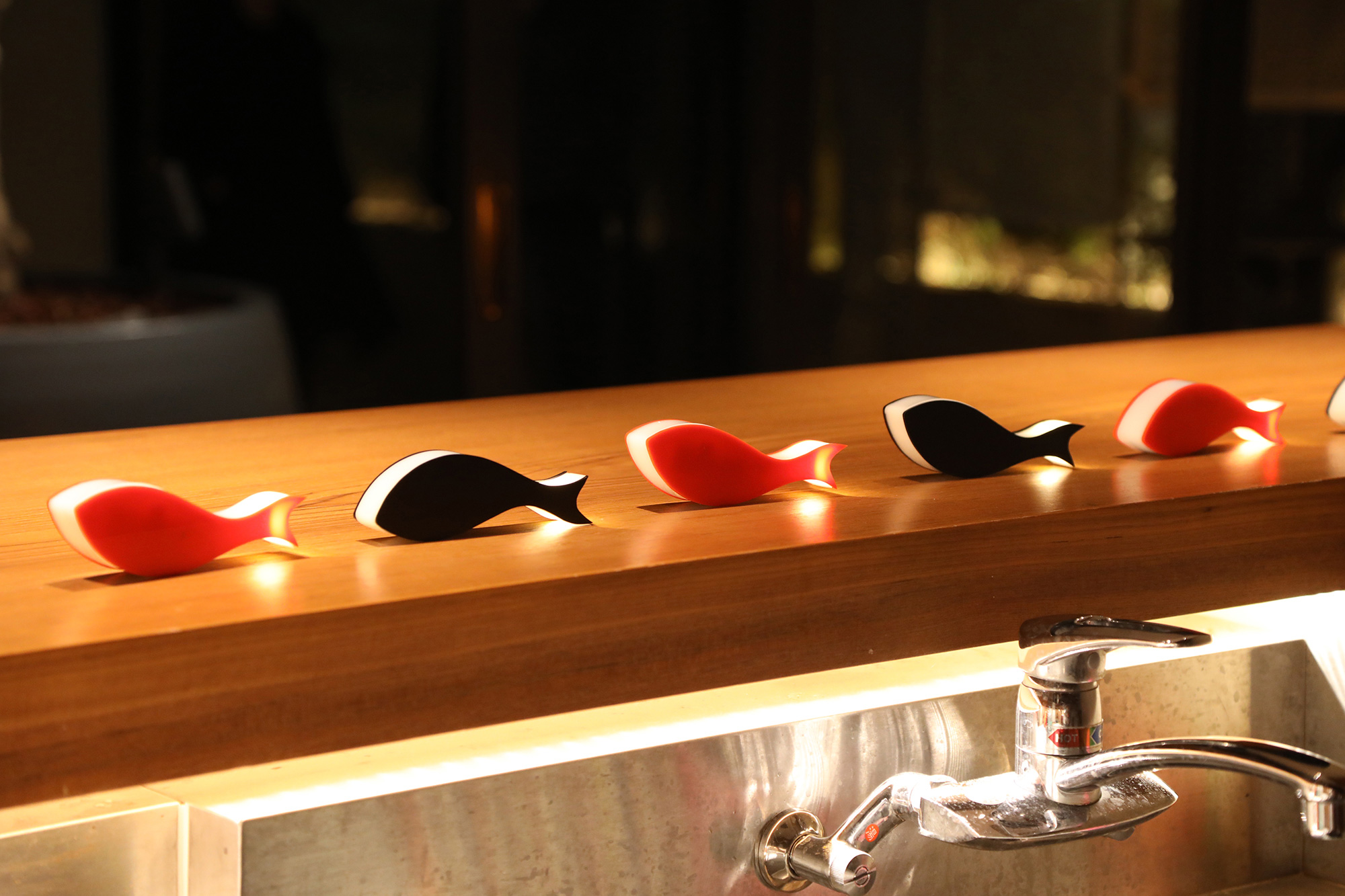
In 2016, Fish traveled to Italy for SaloneSatellite 2016 — the young-designer gateway within Milan Design Week (Salone del Mobile), one of the world's largest design fairs. Shown alongside Kvel, a candle light that responds to sound, the novelty and beauty of its schooling, responsive glow drew high praise from international visitors.
Looking back, it was exactly this behavior of Fish — light being handed from one to the next — that became the core idea behind SHAKE SYNC.
The Fish Became a Diamond
The turning point was meeting HACKTS, the creative team at Hakuhodo's Kansai office — a team on a mission to unearth excellent technologies dormant in universities and turn them into products that reach everyday life.
As development built on Fish, designer Saori Nakayama gradually reshaped it. What it finally arrived at was a diamond (rhombus).
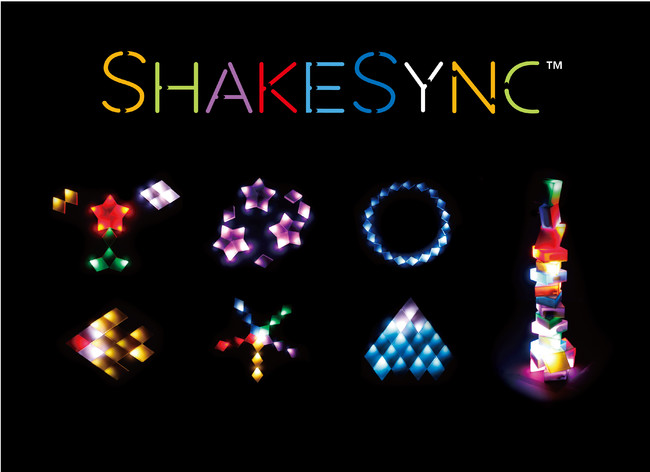
There's a reason for that shape. Its angle is 72 degrees — line up five of them and you get 360 degrees: a flower. It reads as a triangle or as a square; from a single simple form you can build flowers, rings, and towers. "Rather than adding more shapes, enjoy light with austere devotion through one form." Ornament was stripped away, and even the material — a milky, shoji-paper-like translucent resin — was chosen after dozens of trials. Simple, yet a genuinely new sensation. That single idea was what everyone bet on.
Play Is Utterly Simple
SHAKE SYNC needs almost no manual.
- Shake to turn it on. A shake, and the light comes alive.
- Shake again to change the color. Another shake, and the color shifts.
- Bring it close to pass the color on. The blocks respond to one another, handing the light across.
- When you're done, shake to turn it off.
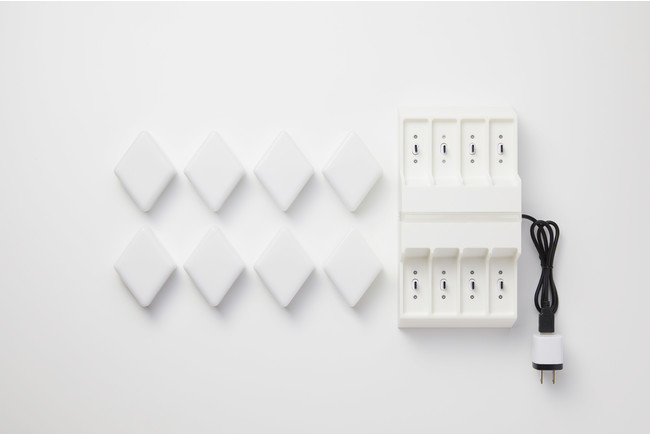
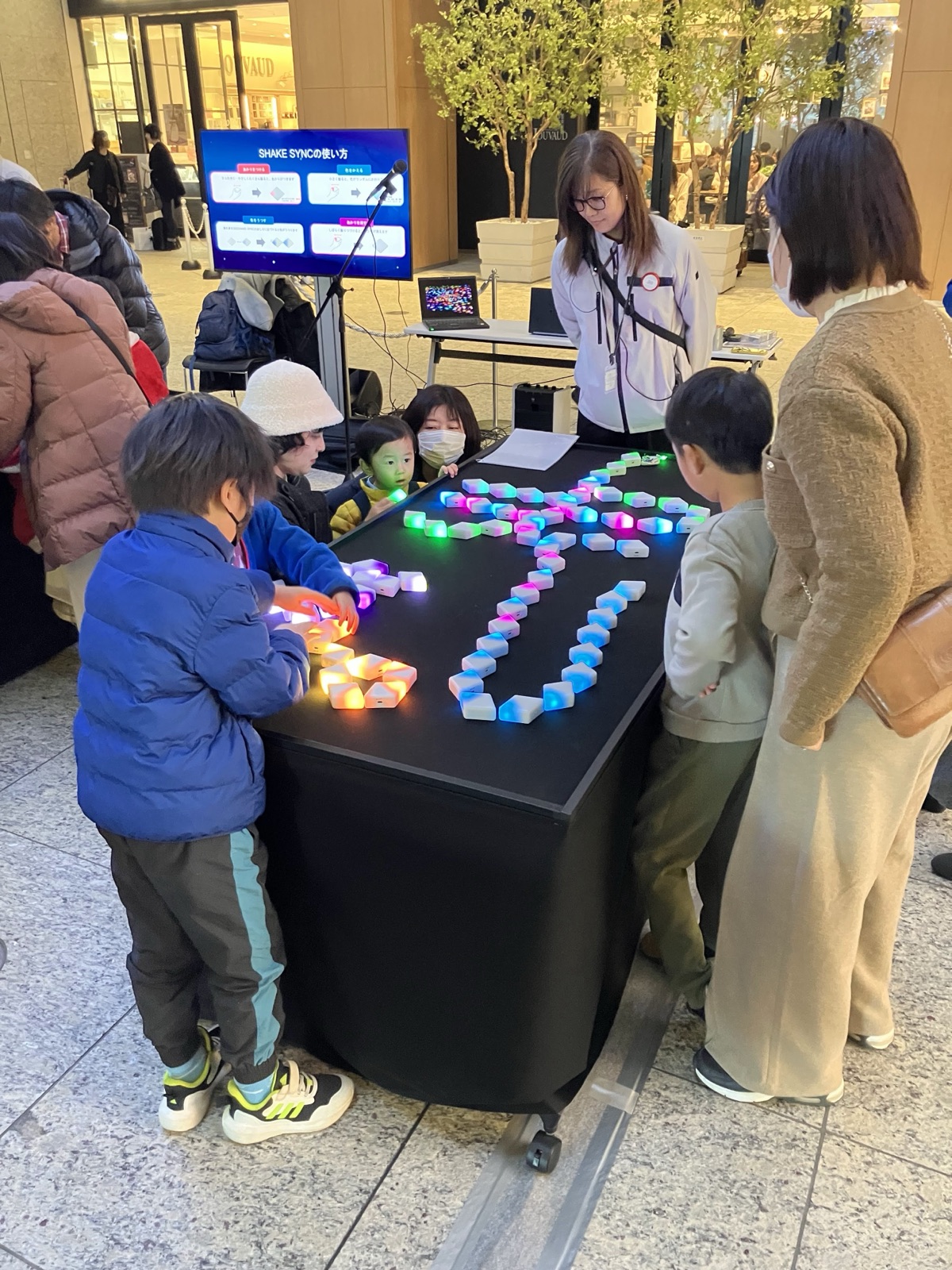
Line them up and you get a "domino of light"; connect them like a puzzle and you can draw pictures in light — flowers, fish, fireworks. Thinking about how to light them and how to pass the color along quietly nurtures not only computational thinking but sensitivity and creativity. One set is eight blocks and a charger. The light carries that "1/f fluctuation," so although it's digital, you somehow never tire of holding it.
What Can Interactive Art Actually Do?
We set out, in the end, from a single question: what kind of social value can interactive art create?
Where SHAKE SYNC proves especially powerful is in caring for children with developmental disabilities. Its softly wavering 1/f light carries a "Snoezelen"-like effect, gently calming an overstimulated nervous system. But there's more. A small action of your own — a shake, a touch — comes straight back to you as art in light. That responsiveness gives even children who find it hard to engage actively a reason to think, "I want to try this myself."
Because it can draw out the spontaneous act of reaching out a hand, it also holds promise for rehabilitation. Stack, spread, change the color — the ways to play are endless, and the "work" that results is entirely different for each person. A child with few experiences of being recognized can communicate with those around them through their expression, while carers come to notice that child's own individuality from what they make — "loves blue," "loves to stack." It can even surface the still-unknown talents of especially sensitive children.
Until now, equipment aiming for this kind of Snoezelen effect has mostly meant large-scale installations; a minimal product you can handle in your own hands has been almost nonexistent. That crossing of "relaxation" (the soft, wavering 1/f light) with "exploration" (touch it, bring it close, and the light responds) sits at the very core of SHAKE SYNC.
Disability or not, children and adults can play side by side, on equal footing, recognizing in one another each person's expressive character — "loves blue," "loves circles." Tearing down walls through the power of art, toward a world everyone can enjoy on the same plane: in that sense too, SHAKE SYNC is a product that holds out a possibility.
The Challenge of Connecting Sound
If light can move to a neighbor, then surely sound can too.
In collaboration with the audio manufacturer TOA, oxoxo also took on an experiment to extend the SHAKE SYNC idea into sound — passing sound from block to block the way the light is handed across, broadening the experience of "connecting" from the visual into the audible. Move your hands, and the light changes as the sound links up; the interplay pulled play into an even deeper immersion.
Out into the World
SHAKE SYNC has been shown in many places, in Japan and abroad.
At SXSW 2018 (Austin, USA) it appeared at the Hakuhodo booth under the theme "CARESS YOUR BRAIN." — a booth gathering products that start not from technology but from people, gently engaging emotion and bodily sensation. International visitors who shared no common language became absorbed in it with no explanation needed — shake for color, bring close to transfer it — and filmed it on the spot to share on social media, day after day.
What struck us most on the ground was the importance of "yohaku" — leaving room. The people who come to the SXSW trade show are there to meet an "Amazing / Interesting Idea," even an unfinished one, more than a finished "Great Product." The more a thing carries open space — no prescribed "right" way, something you can hand over saying "It's up to you!" — the more visitors would pause, then start happily describing their own use for it. That very yohaku is what let SHAKE SYNC cross the language barrier.
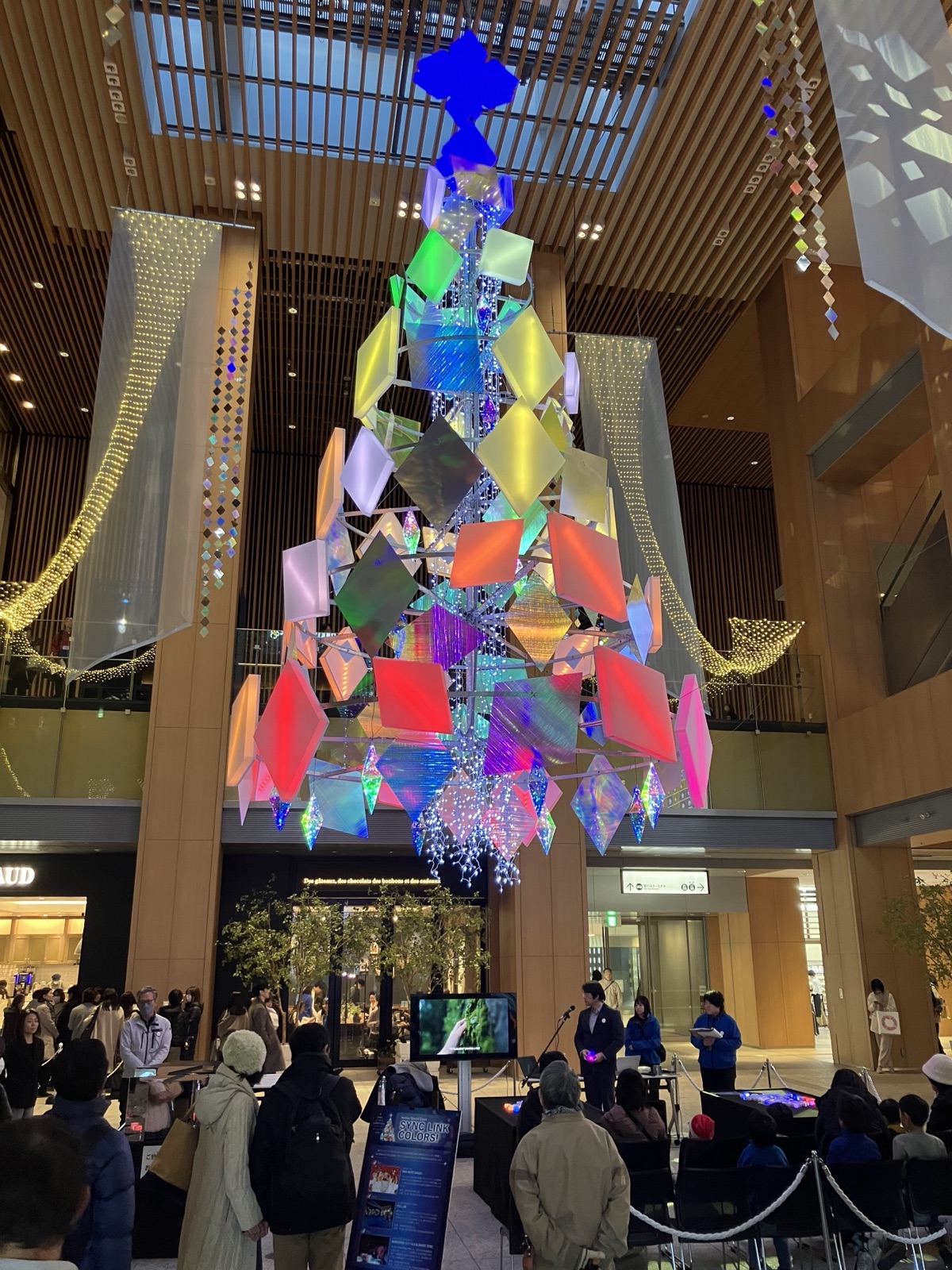
From there — Maker Faire Tokyo 2018, a showing in Okayama (RSK Sanyo Broadcasting), a Christmas event at KITTE Nagoya — it kept spreading to places where light draws people together. At KITTE Nagoya, those very diamond blocks became a giant Christmas tree, an interactive illumination where visitors shook SHAKE SYNC to change the tree's colors.
So What's the Fun?
One last, most important thing. SHAKE SYNC is a tool that refuses to dictate how you should play.
Because there's no correct way to play, children build flowers while adults simply gaze, absently, at the wavering glow. Stand the blocks before a fully mirrored folding screen and the light scatters, turning the little blocks into an immersive installation. Precisely because the technology and the form were pared down to the utmost, there's that much more room for the player's own imagination to enter. That very yohaku — the open space we felt work so well at SXSW — may be SHAKE SYNC's greatest invention of all.
Shake, change, transfer, arrange. Somewhere in that tactile play lives a new way of relating to light — not merely seeing it, not merely making something, but both at once. Please, pick one up and give it a shake.
Come Play With It in Person
On September 12–13, 2026, oxoxo (zero by zero) will exhibit at the Shinagawa Artist Exhibition 2026, held at Kyurian (Shinagawa Citizens' Hall). You can pick up and play with SHAKE SYNC yourself, and join a mini workshop making flowers, fish, and fireworks from the blocks. Come feel that "shake, and the light moves" sensation for real.
- Work page: SHAKE SYNC
- Official site: shakesync.com